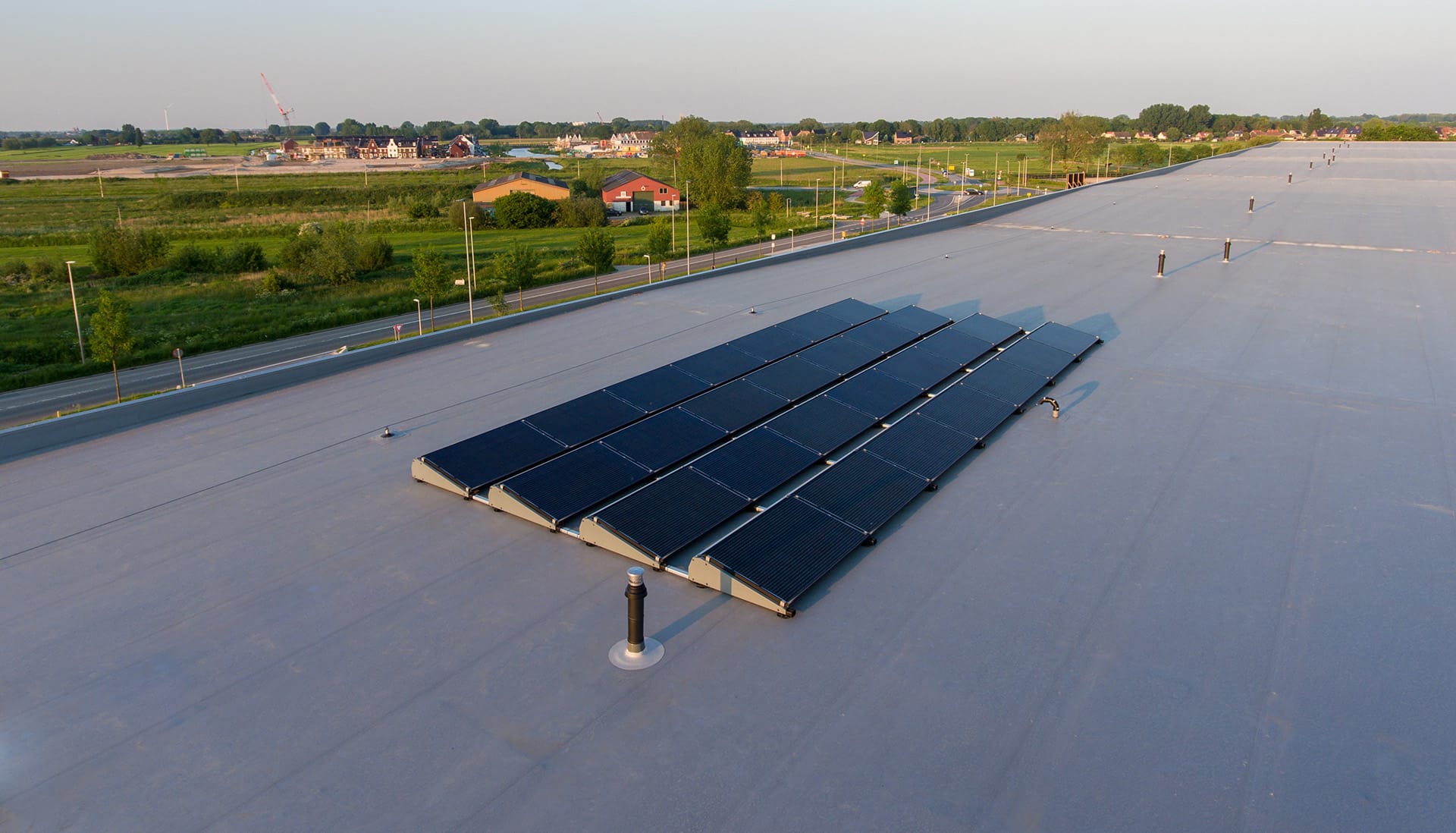
Solar Panels are a popular addition to houses and commercial properties across the country, but can you put solar panels on a flat roof? The simple answer is yes, solar panels on flat roof spaces work really well.
Sometimes, however, your flat roof will need to be checked for strength due to the additional weight added by solar panels.
Flat roofs offer the perfect amount of flexibility for solar panels to collect the optimal amount of sunlight throughout the day, and having them on your roof helps to reduce energy bills!
In this blog, we will discuss how flat roof solar PV systems work, the process of installing them, and the benefits of adding them to your flat roof.
How Do Solar Panels Work on a Flat Roof?
Solar Panels on a flat roof work in pretty much the same way as they do on pitched roof systems; however, they have the added benefit of the mounting system being at the correct tilt angle, meaning the solar capture is maximised.
Mounting systems have to be used when installing solar panels onto a flat roof due to the only slightly sloped roof. These systems will mount solar thermal panels at a certain angle, allowing them to capture the sunlight throughout the day.
Most flat roof solar systems use ballast systems, such as concrete blocks or paving slabs, to hold the panels in place without penetrating the existing roof. These systems are carefully designed to withstand wind forces and high winds, while distributing the added weight evenly across the roof structure.
Do you need Planning Permission for Flat Roof Solar Panels?
In most situations, planning permission is not needed. This is because they fall under permitted development rules; however, there are some exceptions.
You may need planning permission if:
- The property is a listed building
- The building is located in a conservation area
- Panels are clearly visible from street view
- The panels exceed permitted height limits above the roof
Planning permission rules may differ slightly across areas, so it’s important to check with your local authority to ensure compliance.
Installing Solar Panels: Flat Roof Mounting Systems
When installing solar panels, because of the flat nature of flat roofs, they are mounted on special systems that are designed to provide stability, efficiency, and protection.
Ballasted Mounting Systems
Ballasted systems are the most common flat roof solution. They use concrete blocks or paving slabs to hold the panels securely in place without drilling into the roof. This reduces the risk of leaks and helps protect the existing roof membrane.
Free-Standing Systems
Free-standing flat roof systems allow panels to be mounted independently of the roof surface. These systems often require less ballast, reducing additional weight while still resisting wind forces.
Tilted Mounting Systems
Tilted systems raise the panels to the correct angle for optimal solar capture. In the UK, a tilt angle of around 10–15 degrees is commonly used on flat roofs to balance efficiency, wind resistance, and self-cleaning performance.
The Benefits of Installing Solar Panels on your Flat Roof
More Control Over Panel Angle and Position
Flat roofs allow installers to set panels at the ideal angle and orientation, even on a north-facing roof, improving solar capture and overall efficiency.
Better Use of Roof Space
With fewer obstructions and more space per square foot availability, flat roofs often allow for more panels, increasing energy production and helping to reduce energy bills.
Easy Access and Maintenance
Flat roof solar panels are easier to access, making maintenance, cleaning, and inspections less time-consuming. The slight pitch also supports self-cleaning, as rainwater can wash away dirt and debris. Many solar panel systems installed on flat roofs are free-standing, making upgrades to higher-efficiency models easier compared to integrated systems.
Lower Visual Impact
Panels mounted on a flat roof are generally less visible from ground level, which can be beneficial for aesthetics and planning approval.
Compatible with Battery Storage
Flat roof solar systems integrate easily with solar battery storage, allowing homeowners to store excess energy and reduce reliance on the grid during peak energy consumption times.
Long-Term Savings
While installation labour costs for flat roof systems can be slightly higher due to mounting systems and design work. Installing solar panels on a flat roof can save you hundreds of pounds a year on your energy bills.